Can You Get Dental Implants if You Smoke, Have Diabetes, or Have Gum Disease?
Diabetes and gum disease do not rule out dental implants; smoking does. What we check, what has to be controlled first, and when we refer you on.
Read article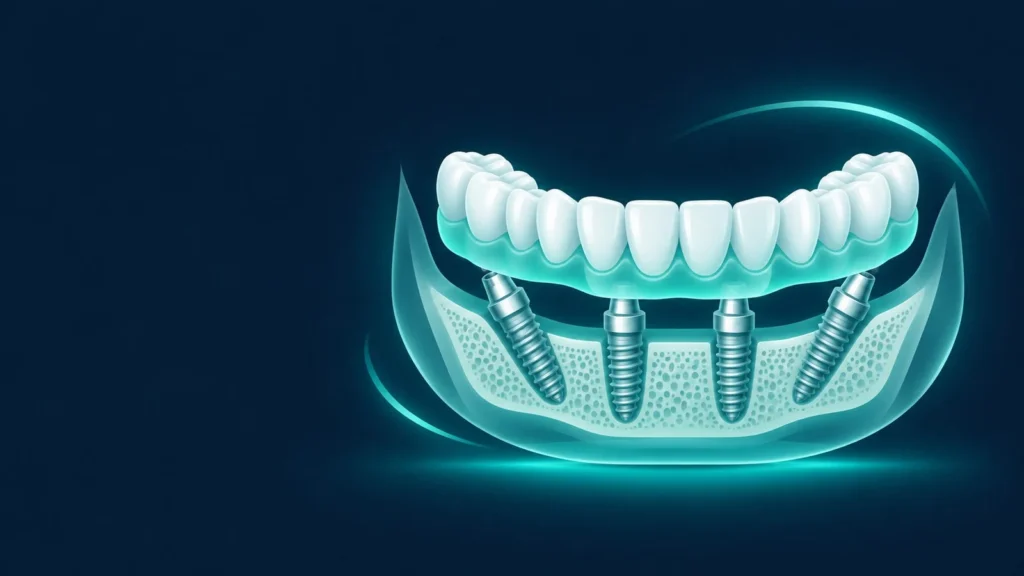
Medically reviewed by Dr. Ali Fatemi, DDS, FAGD, MAGD, FICOI, MaCSD — Fatemi Family Dentistry, Gaithersburg & Lexington Park, MD.
“Teeth in a day” is accurate about the teeth and misleading about the day. You do leave the surgery with a fixed set of teeth that are screwed into your jaw — that part is real. What the phrase leaves out is that those are temporary teeth, that the final ones arrive several months later, and that the months in between have rules. Here is the honest version of the timeline.
One thing to be clear about before anything else: having the temporary teeth attached to the implants on the day is not a guarantee. The stability of the implants at the time of surgery decides whether you can have the fixed temporary. If they are not stable enough, you receive a full denture until the implants have fused to the bone and are stronger.
Instead of replacing each missing tooth with its own implant — twelve or fourteen implants per jaw, which almost nobody needs or can afford — a full arch is carried on four to six implants. A single bridge spans them. The rear implants are usually placed at an angle, which is the whole trick: tilting them lets us engage the solid bone at the front of the jaw and often avoids the sinus or the nerve entirely, so a patient who was told they “need a bone graft first” frequently does not.
“All-on-4” is one well-known version of this. “All-on-X” is the broader term, because the right number is four, five or six depending on your bone, your bite and how hard you chew. Anyone quoting the number before looking at a 3D scan is quoting a brochure.
This is a long appointment — commonly four to six hours per arch — which is precisely why we do it under IV sedation. Dr. Fatemi administers the sedation himself and performs the surgery, so there is no second doctor you have never met, and the depth of sedation is matched minute by minute to what is actually happening in your mouth. Most patients describe the whole thing as a nap.
The bone needs to fuse to the implants — osseointegration — and that takes roughly three to six months regardless of how good the surgery was. During it:
Once the implants have integrated, impressions or a digital scan are taken and the final bridge is made — usually zirconia or a titanium-reinforced material, fitted and adjusted over two or three visits. Total elapsed time from surgery to final teeth: commonly four to eight months.
It suits someone facing the loss of a whole arch, someone whose lower denture has never stayed put, and someone whose remaining teeth are failing one at a time and who is tired of the slow-motion version.
It does not suit everyone. The honest exclusions at this practice:
A starting point for the conversation, not a treatment plan — only an examination of your bone and your remaining teeth can settle it.
Full-arch is the most expensive thing in general dentistry, and a single national average number would be misleading because the variables are large: one arch or two, how many implants, whether extractions and grafting are needed, the material of the final bridge, and the sedation itself. What we can tell you is how we quote it — itemised, before you commit: surgery, implants, the temporary, the final bridge, and sedation each on their own line, so nothing is buried in a monthly figure.
Membership plan members take 20% off treatment, and the balance can be financed; see payment options.
No. The temporary bridge goes on the same day as the surgery. You do not leave without teeth and you do not wear a removable denture while you heal.
The All-on-X bridge described here is fixed — only we can unscrew it. There is also an implant-supported overdenture, which snaps onto two to four implants and you take out to clean. It costs less and solves the “my lower denture moves” problem; it just is not fixed. We will tell you which you are a candidate for.
Published follow-up on full-arch implant bridges is encouraging over ten-plus years in maintained patients, but the implants and the bridge age differently: the implants can last decades, while the bridge is a wearing part that may need repair or replacement. Nobody can promise a number for an individual, and we won’t.
Because the failure mode for a full arch is peri-implantitis — gum disease around implants — and a fixed bridge creates exactly the kind of sheltered space plaque likes. Patients who keep their maintenance visits and clean under the bridge do well. Patients who disappear for three years do not.
The first step is a 3D scan and an honest look at the bone. It tells us whether four implants are enough, whether angling avoids a graft, and whether this is a “now” or an “after we sort something else out”.
See what a sedated implant appointment looks like here →
Still weighing the options? Implants vs. dentures vs. bridges over ten years.
General information, not a diagnosis. Timelines are typical ranges and vary with healing, bone quality and the specifics of your case; costs depend on what you actually need. Please confirm all clinical content against your practice’s regulatory and compliance requirements before publication.
Diabetes and gum disease do not rule out dental implants; smoking does. What we check, what has to be controlled first, and when we refer you on.
Read articleWhy do dental implants fail? The early and late causes, the warning signs worth a phone call, and the eight things we do to lower the odds.
Read articleImplants, dentures or a bridge? How each holds up over ten years — bone, neighbouring teeth, chewing and cost. Reviewed by Dr. Ali Fatemi, Maryland.
Read article
Leave a Reply