Can You Get Dental Implants if You Smoke, Have Diabetes, or Have Gum Disease?
Diabetes and gum disease do not rule out dental implants; smoking does. What we check, what has to be controlled first, and when we refer you on.
Read article
Medically reviewed by Dr. Ali Fatemi, DDS, FAGD, MAGD, FICOI, MaCSD — Fatemi Family Dentistry, Gaithersburg & Lexington Park, MD.
The short version: dental implants are one of the most predictable procedures in dentistry — long-term success rates in the published literature are generally in the mid-90s percent — but “predictable” is not “guaranteed,” and the failures that do happen usually have a reason that could have been managed. Understanding those reasons is the most useful thing a patient can do before choosing an implant dentist. Here they are, honestly.
An implant has “failed” when it is loose, painful, infected, or has lost enough bone that it cannot be kept. It does not mean the crown is chipped (that is a repair) or that the gum around it is red (that is a warning sign, treatable). Failures fall into two groups with different causes: early — the bone never fused to the implant in the first months — and late — the implant integrated, worked for years, and then lost its bone.
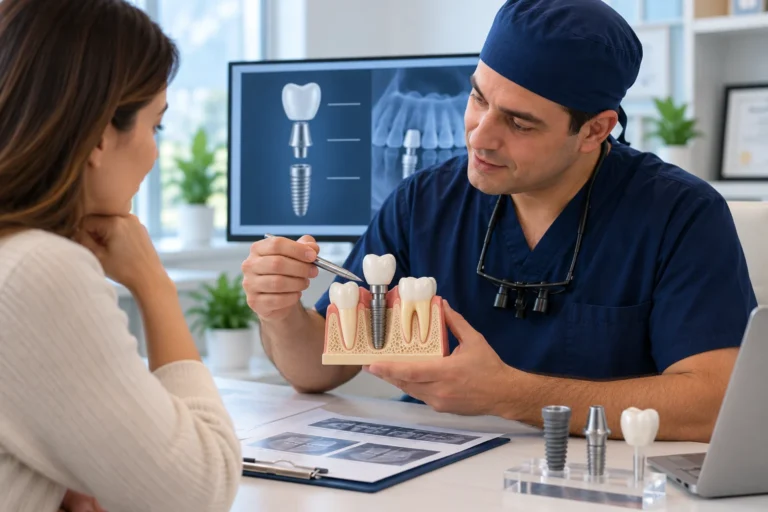
An implant works because bone grows onto its titanium surface — a process called osseointegration that takes roughly three to six months. When it does not happen, the usual reasons are:
An implant that has worked for years fails, when it fails, almost always for one reason: peri-implantitis, gum disease around an implant. Plaque collects at the gumline exactly as it does around a natural tooth; the difference is that an implant has no ligament to slow the infection down, so bone loss around it can be faster and quieter. Risk factors are the same as for gum disease generally — home care, smoking, diabetes, a history of periodontal disease — plus one that is specific to implants: cement left under the crown at the time it was fitted, which acts as a permanent irritant. We use screw-retained crowns where possible for exactly that reason.
Two other late causes are worth naming. Overload: an implant placed at a bad angle, or carrying more bite force than it should because of grinding, can lose bone mechanically. We recommend a custom occlusal guard for every implant patient who grinds their teeth; we have seen implants lost to grinding where that advice was not followed. Neglect: an implant that is never checked cannot be caught early. The single strongest predictor of a long-lived implant is a patient who keeps their maintenance visits.
None of these means the implant is lost — they mean call us:
Early peri-implantitis is treatable — cleaning under the gum, sometimes regenerating bone. Advanced peri-implantitis usually is not. The gap between the two is a phone call made in time.
There is no way to make any surgery risk-free, and any dentist who says otherwise is not being straight with you. What a careful implant practice can do is remove the avoidable causes one at a time:
Dr. Fatemi is a Fellow of the International Congress of Oral Implantologists (FICOI) and a Master of the Academy of General Dentistry (MAGD) — the latter held by a small minority of general dentists, and requiring documented continuing education and examination. Neither letter places an implant; they indicate the training behind the eight steps above. Ask any implant dentist you consider what their planning process is; the answer tells you more than the letters.
Published long-term studies generally report success in the mid-90s percent range over ten years for healthy patients. Individual risk depends on bone, health, habits and maintenance, which is why no honest dentist quotes one number for everyone.
Usually, yes. The site is cleaned, allowed to heal, often grafted, and a new implant placed a few months later. Success on the second attempt is somewhat lower than the first, which is another argument for getting it right the first time.
Established brands with long clinical records matter more than any particular one. Planning, surgical technique and maintenance matter more than the brand.
Rarely too late — but often a graft is needed first, because bone shrinks once the tooth is gone. See how implants compare to the alternatives and why timing matters.
If you are considering an implant, or you have one that has never been checked, the useful step is a scan and an exam. We would rather tell you “graft first” or “this one needs attention” than find out later.
See how dental implants are planned and placed at our Maryland offices →
Have an implant from elsewhere that is worrying you? Call either office — we see plenty.
General information, not a diagnosis. Success rates are drawn from published literature and are not a prediction for any individual; outcomes depend on bone, health, habits and maintenance. Please confirm all clinical content against your practice’s regulatory and compliance requirements before publication.
Diabetes and gum disease do not rule out dental implants; smoking does. What we check, what has to be controlled first, and when we refer you on.
Read articleImplants, dentures or a bridge? How each holds up over ten years — bone, neighbouring teeth, chewing and cost. Reviewed by Dr. Ali Fatemi, Maryland.
Read articleWhy some implants need a bone graft or a sinus lift first, what each procedure involves, and how long it adds to the timeline.
Read article
Leave a Reply