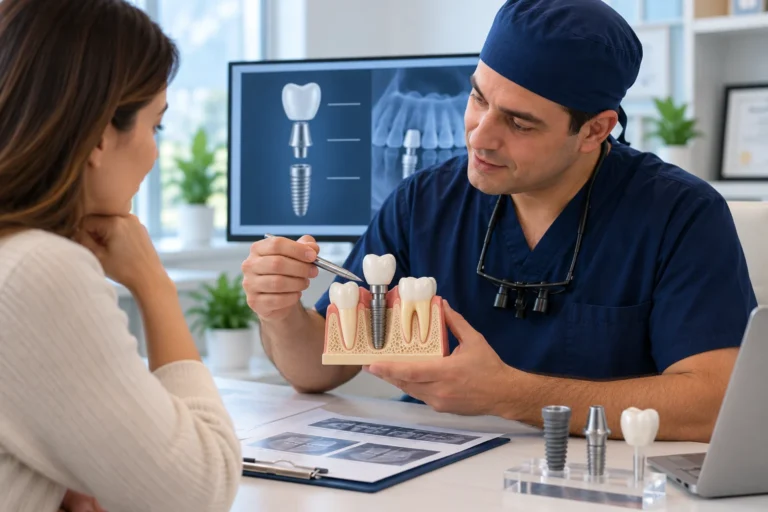
Sinus Lifts & Bone Grafts: The Foundation for Implants
Why some dental implants need a sinus lift or bone graft first, what each one does, and how it fits into implant treatment. Reviewed by Dr. Ali Fatemi, DDS, FAGD, MAGD.
Read article
Medically reviewed by Dr. Ali Fatemi, DDS, FAGD, MAGD, FICOI, MaCSD — Fatemi Family Dentistry, Gaithersburg & Lexington Park, MD.
The short version: dentures are the cheapest on day one, bridges are the fastest, and implants are the only option that behaves like a tooth for the long term — because they are the only option that keeps the jawbone. Which one is right for you depends on how many teeth are missing, what the bone looks like, your health, and how you weigh cost now against cost over ten years. Here is how the three compare on the things that actually matter.
A removable denture is a plate carrying one tooth (a “flipper”), several teeth (a partial), or a full arch. It rests on the gums and, for partials, clips to remaining teeth. You take it out to clean it.
A fixed bridge replaces a missing tooth by crowning the teeth on either side of the gap and suspending a false tooth between them. It is cemented in place and does not come out.
A dental implant is a titanium post placed in the jawbone where the root used to be. The bone fuses to it over a few months, and a crown (or a bridge, or a full-arch prosthesis) is then attached. It stands on its own and touches no other tooth.
| Removable denture | Fixed bridge | Implant | |
|---|---|---|---|
| Time to finish | Weeks | 2–3 weeks | 3–6 months (longer if grafting is needed) |
| What happens to the jawbone | Continues to shrink under the plate; bone loss costs muscle tone and changes the face | Shrinks under the false tooth; bone loss costs muscle tone and changes the face | Preserved — the implant replaces the root and holds the bone in place, which is what makes it the healthier choice |
| Effect on neighbouring teeth | Clasps stress them; partials can loosen them over time | Two healthy teeth are ground down to anchor it | None |
| Chewing | Reduced significantly; hard and sticky foods are difficult | Near normal | Normal |
| Typical lifespan | 5–8 years, with relines as the bone changes through continued bone loss | 5–10 years; the anchor teeth are the weak point | The post: decades; the crown: 10–20 years |
| Daily care | Removed and cleaned; soaked overnight | Special floss under the false tooth | Brushed and flossed like a tooth |
| Cost up front | Lowest | Middle | Highest |
| Cost over ten years | Often approaches a bridge once relines and replacements are counted | Often replaced once; anchor teeth may need root canals or crowns | Usually the lowest maintenance cost after the initial investment |
| Sedation available | Not usually needed | Optional | Yes — the surgery is commonly done under IV sedation here |
When a tooth is lost, the bone that held it has no job to do and begins to shrink — most quickly in the first year. A denture sits on top of that shrinking ridge, which is why it needs relining and eventually stops fitting. A bridge floats above it, so the gap under the false tooth slowly widens. An implant is the only replacement that transmits chewing force into the bone the way a root did, and that stimulation is what keeps the bone where it is. This is also why waiting years before choosing an implant sometimes means a bone graft or sinus lift first: the bone that would have supported it is no longer there.
A bridge is quick and it looks good, but it is built on two teeth that were healthy. Grinding them down for crowns removes enamel permanently, and those teeth now carry the load of three. Over ten years, the most common reason a bridge fails is not the bridge — it is decay or a fracture in one of the anchor teeth, which can turn a one-tooth problem into a three-tooth problem. An implant leaves the neighbours untouched.
A denture makes sense when many teeth are missing, budget is the deciding factor today, or health or bone make surgery unwise. A well-made partial is a perfectly reasonable long-term solution for some patients, and an implant-supported denture — two to four implants that snap a full denture into place — solves the biggest complaint about full dentures, the lower one moving.
A bridge makes sense when the teeth on either side of the gap already need crowns or already have them, when there is not enough bone for an implant and grafting is not an option, or when a fixed result is needed quickly.
An implant makes sense when the neighbouring teeth are healthy, when you want the replacement to last, and when you are in reasonable health. It is the option Dr. Fatemi recommends most often for a single missing tooth in a healthy adult, for exactly the two reasons above: it saves the bone and it saves the neighbours. And because it preserves the bone, it holds the muscle tone of your face better than the alternatives.
For many patients the real barrier to implants is not cost or time but the idea of oral surgery while awake. At our offices the implant surgery — including any extraction or grafting done at the same time — is routinely performed under IV sedation, administered by Dr. Fatemi himself while he does the work. Most patients describe it as a nap and remember little or nothing at all. If that is what has kept you in a denture, read what a sedated implant appointment actually looks like.
For most healthy adults who want to eat normally and keep their facial structure, yes — the higher initial cost is usually offset over ten years by not needing relines, replacements, or work on neighbouring teeth. For some patients a denture is the right call; the honest answer comes from an exam.
Often, yes. The anchor teeth will still need crowns, and the bone under the old false tooth may need grafting, but it is a common conversion.
We wrote a whole article on it: how much dental implants cost in Maryland, with real ranges and what changes the number.
There is no hard deadline, but bone loss is fastest in the first year. The sooner the implant is placed — sometimes on the day of the extraction — the less likely grafting is needed.
If you have one or more missing teeth, or a failing bridge or denture, the useful first step is a look at the bone. A 3D scan and an exam tell us which of the three options is realistic for you — and whether the implant conversation is a “now” or a “first we graft.”
See how dental implants work at our Gaithersburg and Lexington Park offices →
General information, not a diagnosis. Lifespans and costs are typical ranges, not promises; your options depend on your bone, health and existing teeth, reviewed individually. Please confirm all clinical content against your practice’s regulatory and compliance requirements before publication.
Why some dental implants need a sinus lift or bone graft first, what each one does, and how it fits into implant treatment. Reviewed by Dr. Ali Fatemi, DDS, FAGD, MAGD.
Read articleAn honest breakdown of what actually drives dental implant cost in Maryland — the parts, the add-ons, and why one quote differs from another. Reviewed by Dr. Ali Fatemi, DDS, FAGD, MAGD.
Read articleWhat it's really like to get dental implants under IV sedation — the one-dentist model, the timeline, recovery, and who it suits. Reviewed by Dr. Ali Fatemi, DDS, FAGD, MAGD.
Read article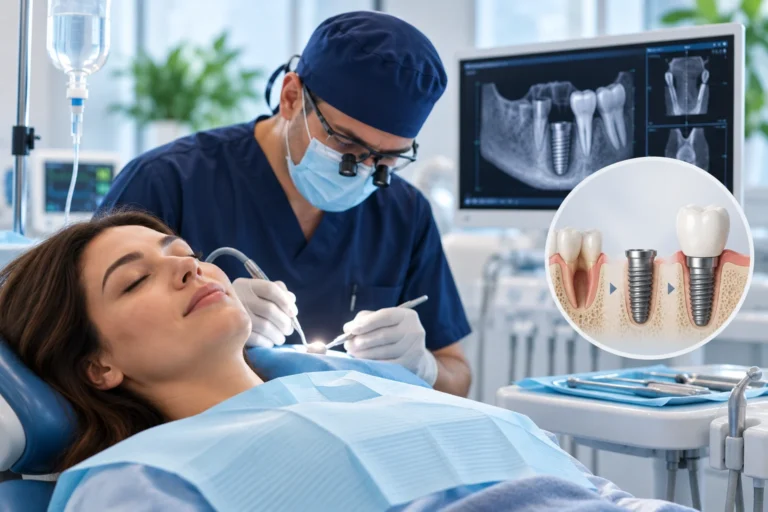
Leave a Reply