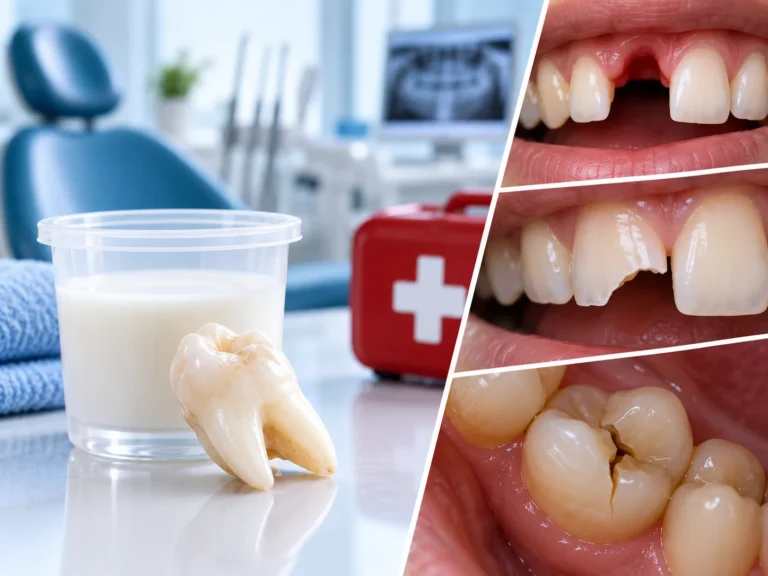
Chipped or Knocked-Out Tooth? What to Do First
A knocked-out tooth has a 30-minute window. What to do first, how to carry it, and when to go to the ER instead of a dentist.
Read article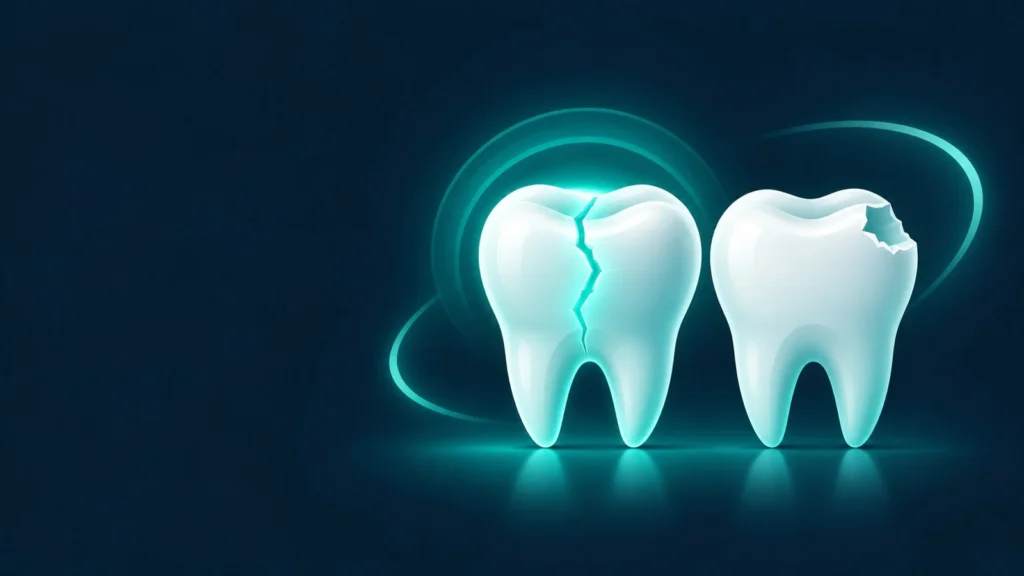
Medically reviewed by Dr. Ali Fatemi, DDS, FAGD, MAGD, FICOI, MaCSD — Fatemi Family Dentistry, Gaithersburg & Lexington Park, MD.
A chip is a piece missing from the outside of a tooth. A crack is a line running into it. The chip is usually the one that looks worse and the crack is usually the one that matters more — because a crack can keep travelling, and once it reaches the nerve or the root, the options narrow fast. Here is how to tell them apart tonight, and what each one actually needs.
Ask yourself: does it hurt when you bite down and then let go?
That specific pattern — a sharp jab on release rather than on pressure — is the classic sign of a crack. The two halves move apart as you bite, then snap back against the nerve when you release. A chip does not do that. A chip is either painless, or sensitive to cold air and sweet things because dentin is exposed.
If biting and releasing produces a sharp zing, treat it as a crack and call us, even if the tooth looks perfectly normal. Cracks are frequently invisible — they do not reliably show on an X-ray either, because the crack runs in the same plane the X-ray travels.
| What you see or feel | What it usually is | When to be seen |
|---|---|---|
| Tiny rough edge, no pain | Enamel only | Routine — smoothing or a small bond at your next visit |
| Visible notch, sensitive to cold or sweet | Into the dentin | Within a week or two; the exposed layer is porous and decays faster |
| Pink or red dot in the middle of the break, throbbing | Into the pulp (the nerve) | Same day. This usually needs root canal treatment to save the tooth |
| Front tooth, large piece gone | Varies | Same day if painful; otherwise soon — and bring the fragment in milk, it can sometimes be bonded back |
In the meantime: cover a sharp edge with a piece of sugar-free gum or dental wax so it stops shredding your tongue, chew on the other side, and skip very hot or very cold drinks.
Dentists classify cracks because the classification decides the treatment, not because it sounds thorough:
The practical point for you is the third one. A cracked tooth caught while the nerve is still healthy is a crown. The same crack caught late is a root canal, or an extraction and whatever replaces the tooth — an implant, a bridge or a partial denture. The gap between those two outcomes is often a matter of weeks, and the symptom that marks it is that bite-and-release jab.
This does not diagnose anything — it sorts your situation into the three groups used on this page.
For a suspected crack the exam is specific, and it is not just an X-ray:
If the tooth needs more than one appointment’s worth of work, or if dental anxiety has been the reason you waited, this is a case where sedation is worth asking about. Dr. Fatemi administers the IV sedation himself while doing the treatment, so a cracked molar, its crown prep and anything else that needs attention can happen in one visit rather than three.
Being honest about this is part of the job. We are not a 24-hour emergency practice and we are not an emergency room. Go to the nearest emergency department, or call 911, for:
Everything else — a cracked molar, a lost filling, a chip, pain that is keeping you awake — is a call to the office. Outside hours you will reach our after-hours message line; messages are picked up the next business morning. A tooth that cracked at 2 a.m. and is not swelling can safely wait for the phones to open.
No. Unlike bone, a tooth has no mechanism to knit a fracture back together. The crack does not close; it either stays stable or travels.
There is no safe number of days, because it depends on how deep the crack already is. The thing that changes the outcome is whether the nerve is still healthy when we see it — so the honest answer is “before the pain changes character”. Constant throbbing instead of a jab on release usually means the nerve is now involved.
Often, not always. A crown works by holding the segments together; if the crack has already reached below the gum or into the root, it cannot. That is why we test the nerve and look at the root before promising anything, and why we will tell you plainly when a tooth has a poor outlook rather than crowning it and hoping.
It is one of the main causes, alongside large old fillings and biting something hard. If you grind, a custom occlusal guard is the cheapest dentistry you will ever buy — it protects the teeth you still have and, if you have implants, it protects those too.
If biting and releasing gives you a sharp jab, call rather than wait and see — that symptom is the window, and it closes. Gaithersburg (301) 740-2686 · Lexington Park (301) 737-4747.
See how we handle dental emergencies at both Maryland offices →
Tooth knocked out or badly broken instead? That one has its own first-30-minutes guide.
General information, not a diagnosis. Cracks vary enormously and only an examination can tell you which kind you have. We are not a 24-hour emergency practice; if you have swelling affecting breathing or swallowing, uncontrolled bleeding, or a head or jaw injury, call 911 or go to the nearest emergency room.
A knocked-out tooth has a 30-minute window. What to do first, how to carry it, and when to go to the ER instead of a dentist.
Read article
Leave a Reply