Is Sedation Dentistry Safe? What We Check Before Every Appointment
Is sedation dentistry safe? The screening before, the monitoring during, and who we will not sedate in a dental office. Reviewed by Dr. Ali Fatemi.
Read article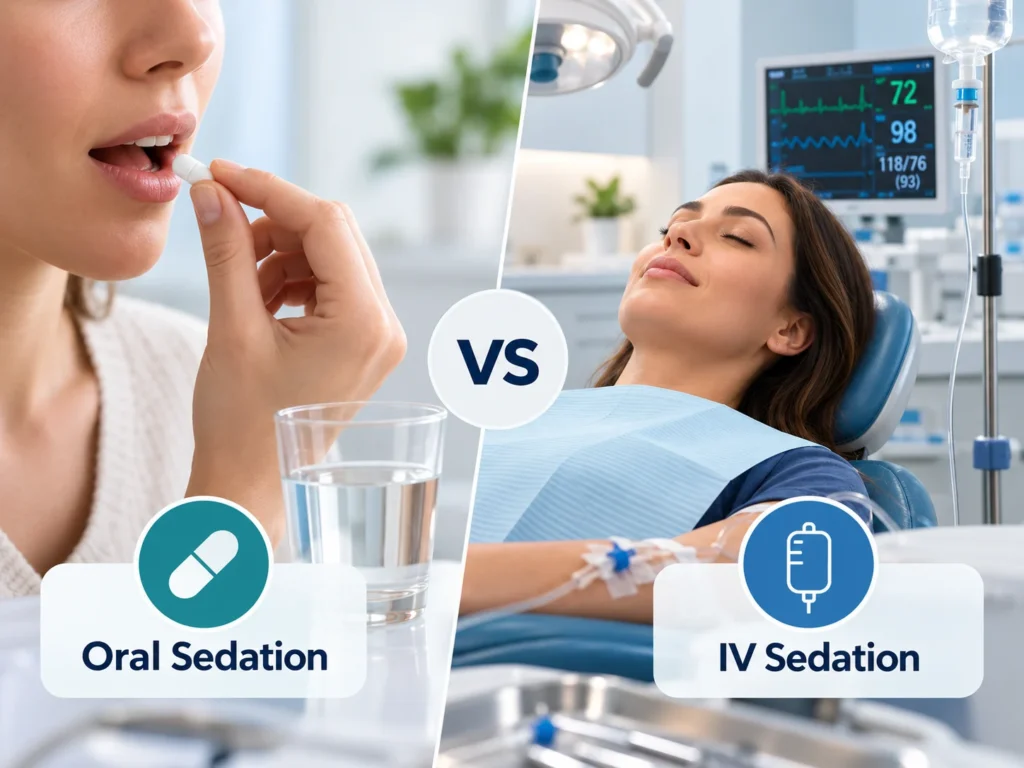
Medically reviewed by Dr. Ali Fatemi, DDS, FAGD, MAGD, FICOI, MaCSD — Fatemi Family Dentistry, Gaithersburg & Lexington Park, MD.
The short version: oral sedation takes the edge off; IV sedation lets us adjust your comfort in real time and usually erases the memory of the visit. Both are “conscious sedation” — you keep breathing on your own — but the control they give the dentist is different, and that difference is what should decide between them, not the word “IV.”
An oral sedative is a fixed dose. You swallow a pill, and whatever effect that dose produces is the effect you get for the next few hours — we can’t dial it up if you’re still anxious or down if you’re too drowsy. IV sedation is delivered through a vein, so it takes effect within a minute or two and can be titrated: adjusted up or down during the appointment to match exactly how you’re doing. For a long or complex procedure, that adjustability is the whole point.
| Oral sedation | IV sedation | |
|---|---|---|
| How it’s given | A pill before your visit | Through a vein during the visit |
| Onset | 30–60 minutes | 1–2 minutes |
| Depth | Light to moderate, fixed | Moderate, adjustable in real time |
| Memory of the visit | Usually partial | Usually little to none |
| Best for | Mild–moderate anxiety, shorter visits | Higher anxiety, longer or surgical visits |
| Driver home needed | Yes | Yes |
| Fasting beforehand | Follow our instructions | No food for 6 hours |
We don’t start from “which sedation do you want?” We start from two questions: how much anxiety are we managing, and how much treatment are we doing? A single filling for a mildly nervous patient rarely needs IV. A full day of implant surgery, a patient with special needs, an extensive restorative appointment where many teeth are being restored, or a patient who hasn’t been able to sit through a cleaning in a decade, usually does. Because Dr. Fatemi administers the IV sedation himself while performing the dentistry, the sedation plan and the treatment plan are made by the same person — the depth is matched to the actual work, not booked blind in advance.
Neither is general anesthesia. You are not fully unconscious with either; you can respond to us, and you keep breathing on your own — the term you’ll often hear for this is twilight sedation. Oral sedation, specifically, will not reliably get a severely phobic patient through dental treatment — expecting it to is the most common mismatch we correct. And neither removes the need for local anesthetic at the treatment site; sedation calms the whole body, while numbing handles the specific tooth.
Sedation is also cardio-protective: it lowers blood pressure during treatment, which makes care safer for patients who have high blood pressure.
After oral sedation you’ll feel groggy for several hours as the pill wears off on its own schedule. After IV sedation, recovery often feels cleaner because the medication clears predictably and we control when it stops — but you should still keep the whole day free and have someone drive you. For either, plan nothing that afternoon.
If you are having IV sedation, Dr. Fatemi also has the option of administering a reversal agent, which speeds recovery up.
If your procedure is short and your nerves are manageable, oral sedation may be all you need. If you’re facing something longer, you’ve had trouble getting numb or sitting still, or anxiety has genuinely kept you from care, IV sedation is usually the better-matched tool. The honest answer for your situation comes out of your health history and what you actually need done.
If you would like a sedation visit, you’ll first be medically evaluated by Dr. Fatemi. He reviews your medications and health history, checks your airway and lungs, and takes your blood pressure and pulse, among other checks, before clearing you for sedation. For patients with more extensive medical issues, he may ask for medical clearance from your physician.
See how IV sedation dentistry works at our Maryland offices →
Caring for a patient with special healthcare needs? That decision has extra considerations — talk with our team first.
General information, not a diagnosis. The right sedation for you depends on your medical history and current medications, reviewed individually. Please confirm all clinical content against your practice’s regulatory and compliance requirements before publication.
Is sedation dentistry safe? The screening before, the monitoring during, and who we will not sedate in a dental office. Reviewed by Dr. Ali Fatemi.
Read articleHow sedation makes dental care possible for patients with special healthcare needs — what to expect, how caregivers are involved, and how we plan it. Reviewed by Dr. Ali Fatemi, DDS, FAGD, MAGD.
Read articleHow long IV dental sedation lasts during and after your visit, the real recovery timeline, and what to plan for the rest of the day. Reviewed by Dr. Ali Fatemi, DDS, FAGD, MAGD.
Read article
Leave a Reply