Is Sedation Dentistry Safe? What We Check Before Every Appointment
Is sedation dentistry safe? The screening before, the monitoring during, and who we will not sedate in a dental office. Reviewed by Dr. Ali Fatemi.
Read article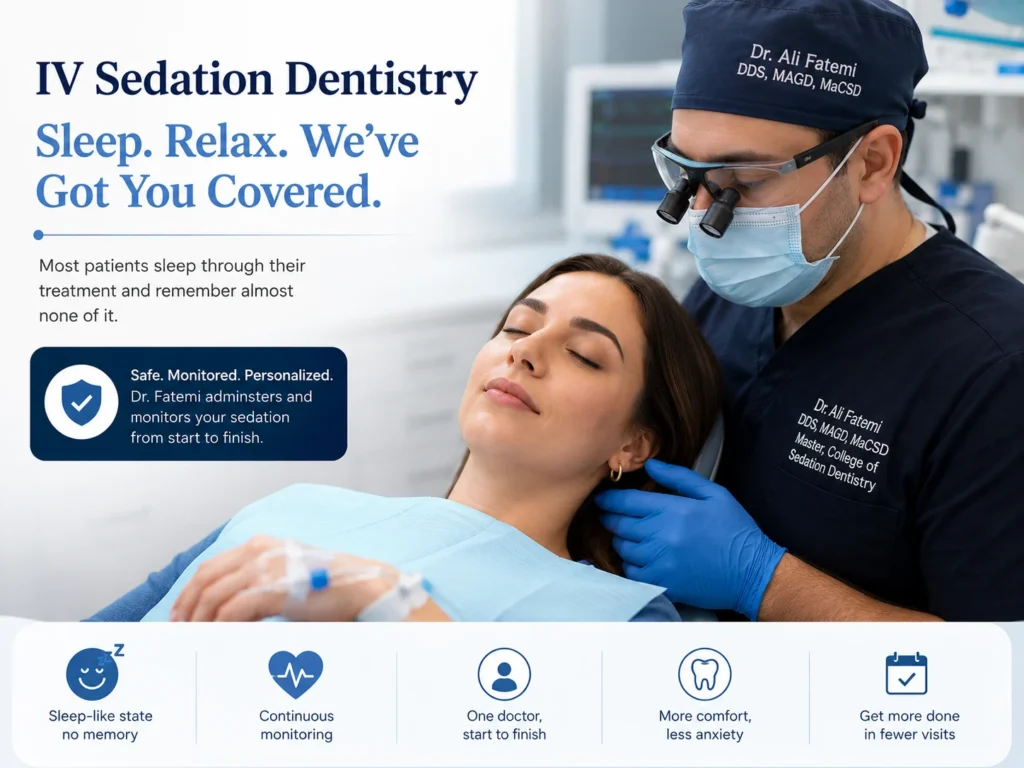
Medically reviewed by Dr. Ali Fatemi, DDS, FAGD, MAGD, FICOI, MaCSD — Fatemi Family Dentistry, Gaithersburg & Lexington Park, MD.
Yes. With intravenous (IV) sedation, most people genuinely sleep through their dental treatment and remember almost none of it. The part worth understanding before you book is who is watching you while you’re under — because at our offices the same dentist who does your treatment also administers and monitors your sedation.
“Asleep” covers a wide range. For dentistry it usually means one of three levels, and they are not interchangeable:
For the vast majority of anxious patients, IV sedation does the whole job without the cost, logistics, or recovery of hospital general anesthesia.
Oftentimes you are also premedicated before the visit, to relax you and to help the sedative drugs work more effectively.
Here is the honest sequence, because “you won’t feel a thing” skips the part people are actually nervous about:
You will need a responsible adult to drive you home, and you should plan to rest for the remainder of the day.
Many practices that advertise sedation either refer you to a separate anesthesia provider or bring one in for the day. That means two schedules, sometimes two bills, and a person managing your airway who isn’t the person managing your teeth.
Dr. Fatemi holds a Master of the College of Sedation Dentistry (MaCSD), a Mastership in the Academy of General Dentistry (MAGD) and Maryland dental sedation permit #11720, and administers IV sedation himself, in-office, at both our Gaithersburg and Lexington Park locations. The clinical advantage is simple: the person adjusting your sedation is the same person who knows exactly how much treatment is left and how your body is responding to it. Nothing is handed off mid-procedure.
It isn’t only for “nervous” patients. It’s the right tool when:
These patients are frequently designated as special needs. Dr. Fatemi has helped many patients with special needs and takes great pride in doing so.
IV sedation performed by trained, credentialed providers with continuous monitoring has a strong safety record. The safeguards that make it safe are specific and non-negotiable: the fasting window, a full health and medication history taken beforehand, continuous monitoring throughout (ECG for your heart, pulse oximetry and capnography for your breathing, plus blood pressure and direct observation), and a provider trained to manage sedation — not just to perform dentistry. We review your medications and medical conditions before we ever schedule a sedation appointment, because some of them change the plan.
If fear or a bad past experience is the only reason you haven’t had dental work done, sedation removes that reason. The next step is a conversation, not a commitment: we look at what you need, review your health history, and tell you honestly whether IV sedation, oral sedation, or simple local anesthetic is the right fit.
Learn more about IV sedation dentistry at our Maryland offices →
Or contact our Gaithersburg or Lexington Park office to ask about sedation for your specific situation.
This article is general information, not a diagnosis or treatment plan. Whether sedation is appropriate for you depends on your health history and current medications, which we review individually. Please have this and all clinical content confirmed against your practice’s regulatory and compliance requirements before publication.
Is sedation dentistry safe? The screening before, the monitoring during, and who we will not sedate in a dental office. Reviewed by Dr. Ali Fatemi.
Read articleHow sedation makes dental care possible for patients with special healthcare needs — what to expect, how caregivers are involved, and how we plan it. Reviewed by Dr. Ali Fatemi, DDS, FAGD, MAGD.
Read articleHow long IV dental sedation lasts during and after your visit, the real recovery timeline, and what to plan for the rest of the day. Reviewed by Dr. Ali Fatemi, DDS, FAGD, MAGD.
Read article

Leave a Reply